
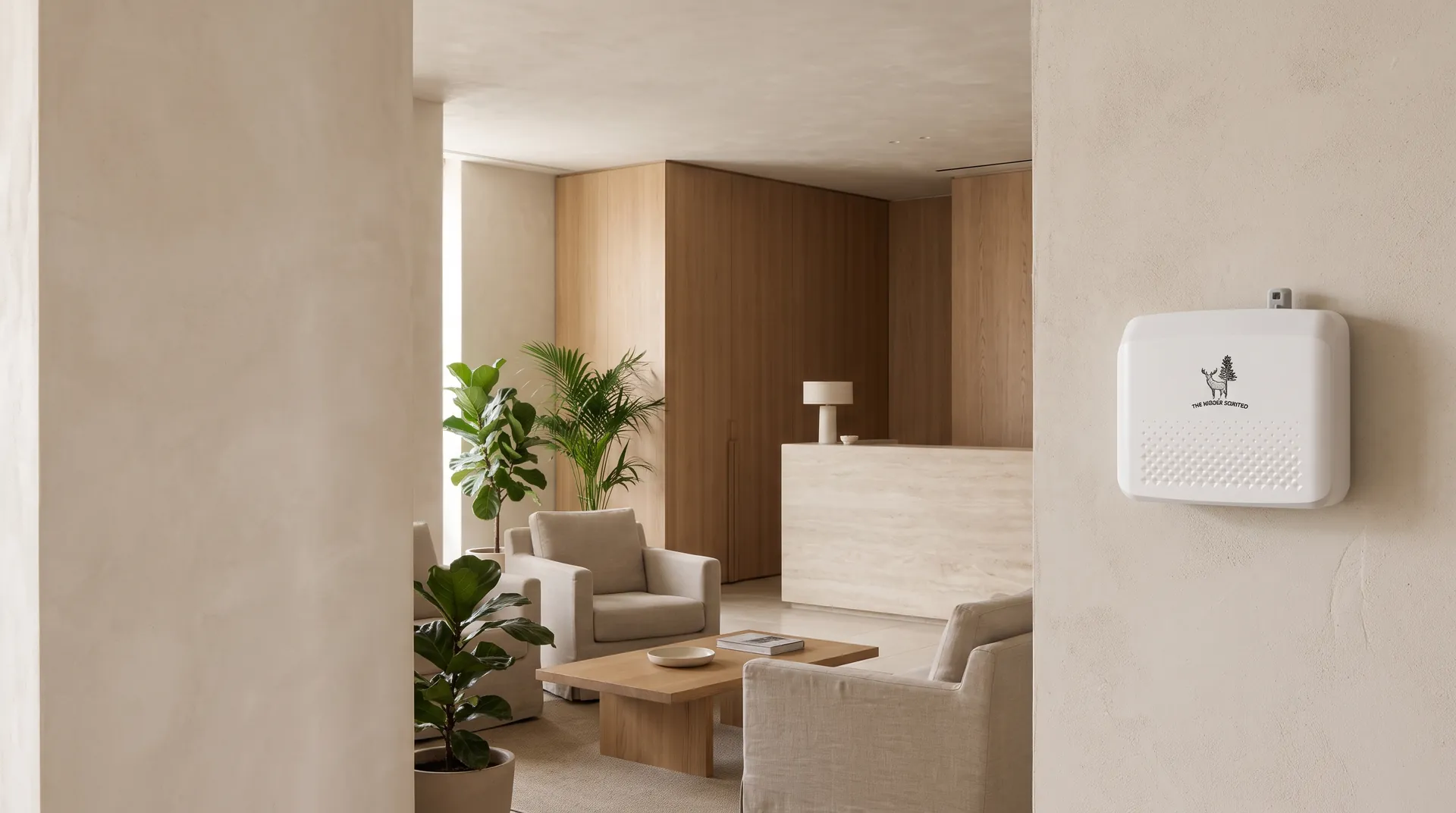
Hotel Scent Diffuser Guide 2026: Models, Placement, Cost
A hotel scent diffuser is chosen by coverage area: TMS150 for small rooms, TMS400 for a mid-size lobby, TMS800 for a flagship lobby, and HVAC Nano Scent connected to the AHU for areas over 800 sqm. Rental starts from 1,000 THB per month (excl. VAT), including fragrance, refills, and maintenance.
A hotel scent diffuser is a fragrance-distribution system designed to cover large public areas — the lobby, corridors, the spa — consistently throughout operating hours. Unlike a general-purpose diffuser built for a small room or a single spot, a hotel system has to be matched to the actual square metreage of each zone, and it has to hold the same signature scent across every point a guest touches.
What Is a Hotel Scent Diffuser, How Does It Differ From a Regular One, and Why Does the Lobby Need Scent Marketing?
Short answer: a hotel scent diffuser is built to run continuously across public space for hours a day, and the model has to be chosen against the actual area it covers — not a single all-purpose unit used everywhere.
The lobby is where a guest meets the hotel's brand before they even see the front desk. Scent Marketing in this space acts as a signal of brand character — a consistent scent every time a guest walks through the door keeps the lobby experience the same on every visit, whatever the hour, and ties back to the familiarity a returning guest already associates with the brand.
Retail diffusers sold off the shelf are generally built for rooms of a few square metres, refilled by hand, with no scheduling tied to a business's real operating hours. A hotel system needs automatic on/off scheduling, a monthly refill visit, and room to expand as the hotel adds or renovates a zone.
Standalone Diffuser vs. HVAC Nano Scent: Which Fits Which Hotel?
Short answer: a Standalone Diffuser suits a self-contained space up to 800 sqm; HVAC Nano Scent suits a hotel with a central air-handling unit (AHU) that needs scent carried throughout a building over 800 sqm.
A Standalone Diffuser sits directly in the space it serves. It suits boutique hotels, guesthouses, or a zone with its own scent identity — a spa room, a VIP washroom, a fitting room. HVAC Nano Scent, by contrast, connects the scent system directly into the building's air-conditioning system (AHU), so fragrance travels with the air-conditioning across an entire zone. It suits a larger hotel whose lobby opens into an atrium or spans several connected floors.
The choice between the two comes down to the building's structure and the monthly budget, more than personal preference. A hotel that already runs an AHU and wants consistency across a whole floor usually gets more value from HVAC Nano Scent, while a hotel with clearly separated zones has more flexibility with a set of Standalone units. Full model details are available at all services and diffuser models (Standalone / HVAC Nano Scent).
How Many Square Metres Need Which Model, and How Many Units? Calculating Coverage Before Installation
Short answer: measure the actual usable area of each zone, then match it against each model's coverage range. Open, high-ceilinged spaces may need more than one unit for the scent to reach every corner.
The calculation starts by breaking the hotel into zones, then measuring the coverage area of each one in square metres before matching it against the table below.
| Model | Coverage | Monthly rate |
|---|---|---|
| TMS150 | 1–20 sqm | 1,000 THB per machine per month (excl. VAT) |
| TMS400 | 21–100 sqm | 2,500 THB per machine per month (excl. VAT) |
| TMS800 | 101–500 sqm | 4,500 THB per machine per month (excl. VAT) |
| TMS1000 | 501–800 sqm | 5,500 THB per machine per month (excl. VAT) |
| HVAC Nano Scent | 800–5,000+ sqm | from 8,500 THB per month (excl. VAT) |
A mid-size hotel lobby of roughly 60–80 sqm is usually served well by a single TMS400. A flagship lobby over 300 sqm, or one with unusually high ceilings, often needs a TMS800, or several units working together, to match the real footprint of the space. To confirm the right number before committing, the team recommends the machine-size calculator, or a direct site survey.
Where Should a Hotel Install Diffusers? Lobby, Elevators, Corridors, Guest Rooms and the Spa
Short answer: the highest-value points are the ones guests pass through repeatedly each day — the lobby, elevator lobbies, corridors leading to guest rooms, and the spa. Within guest rooms, most hotels install only in premium rooms or suites.
The lobby should be the first installation priority — it is the first touchpoint, and the place guests spend the longest time, waiting at check-in. Next come the elevator lobby and the corridors to guest rooms, usually served by a TMS150 or TMS400 depending on how enclosed the space is. The spa and VIP washrooms typically take a TMS150, since these are small, enclosed spaces that call for a more concentrated, localised scent.
Most hotels do not install in every guest room, choosing instead the suites or premium rooms where a distinct impression matters from the moment the door opens. Planning the full set of installation points should be done with a site survey team, since ceiling structure, airflow from air-conditioning, and the height of each zone directly affect how the scent spreads.
The lobby is where a guest meets the hotel's brand before they even see the front desk.
How Do You Choose a Scent That Fits the Brand, and Can a Hotel Build Its Own Signature Scent?
Short answer: the right scent for a hotel should reflect the brand's character, not simply follow what is generally popular. Moose & Pine blends every scent in-house from premium imported fragrance bases, which makes it possible to design a genuine Signature Scent for each brand rather than buy an off-the-shelf fragrance.
Choosing a scent starts with interpreting the hotel's character. A beachside resort tends to suit something light and airy, while a city-centre business hotel often leans toward something more composed and formal. The Signature Scent process at Moose & Pine runs through our Scent Lab, which uses AI to choose from our own scent database and blend a scent unique to each brand — so the result is not shared with any other hotel.
Anyone interested in designing a brand-specific scent can start with the Signature Scent consultation service, where the team begins by understanding the brand's character before presenting scent options to trial.
Monthly Rental or Outright Purchase: Which Is Better for a Hotel, and How Should the Monthly Budget Be Worked Out?
Short answer: monthly rental is the better option for most hotels, since there is no machine to buy upfront, and the monthly fee already includes fragrance refills, maintenance, and a replacement unit.
The rental starts from 1,000 THB per month (excl. VAT).
- TMS150 — 1–20 sqm — 1,000 THB per machine per month (excl. VAT)
- TMS400 — 21–100 sqm — 2,500 THB per machine per month (excl. VAT)
- TMS800 — 101–500 sqm — 4,500 THB per machine per month (excl. VAT)
- TMS1000 — 501–800 sqm — 5,500 THB per machine per month (excl. VAT)
- HVAC Nano Scent — 800–5,000+ sqm — from 8,500 THB per month (excl. VAT)
The monthly fee covers the following — the main reason most hotels choose to rent rather than buy, since there is no fragrance stock to manage and no need to find a technician when a machine needs attention.
- the scent diffuser itself (no machine to buy)
- premium-grade fragrance from The Moose Scented
- automatic on/off scheduling set to your opening hours
- a monthly on-site refill visit by our staff (within the on-site service area)
- maintenance, and a replacement machine if a unit has a problem
- a usage data report (Data-Driven Report)
Hotels planning a detailed monthly budget can review pricing and service packages to compare models against the number of zones they want covered, or start from the monthly diffuser rental for hotels page to ask about the package that fits the property's size.
Safety, Refills, and After-Sales Service for Hotels Outside Bangkok
Short answer: every fragrance comes with MSDS documentation from the base manufacturer. Installation is available nationwide, but monthly on-site refill visits are limited to Bangkok, its surrounding provinces, and Chonburi as far as Bangsaen. Hotels outside that area receive their monthly fragrance by post instead.
Safety is a priority for most hotels, since the lobby and corridors are spaces staff spend far longer in than any single guest. Every fragrance Moose & Pine uses carries MSDS (Material Safety Data Sheet) documentation from the base manufacturer.
For hotels in Bangkok, its surrounding provinces (Nonthaburi, Pathum Thani, Samut Prakan, Samut Sakhon, Nakhon Pathom), and Chonburi as far as Bangsaen, staff visit on site every month to refill the fragrance directly. For hotels elsewhere in the country, the team still installs on site nationwide, then ships fragrance monthly by post for the hotel's own staff to refill on schedule.
For hotel groups with multiple properties across different regions wanting the same scent everywhere, the principle is to set a single Signature Scent from the start, then apply the same formulation at every property through the monthly fragrance shipment system — whether that property sits within the on-site refill area or relies on postal delivery. This way, a guest staying at more than one property in the group encounters the same scent every time. Examples of past installations can be found at Moose & Pine installation examples.
For a deeper strategic view on building a signature scent for a hotel brand, see the article on Scent Marketing for hotels, or for a seasonal approach to scent design, see the article on Valentine's Day scent marketing for hotels and restaurants.
Frequently Asked Questions
How is a hotel scent diffuser different from a regular one?
A hotel scent diffuser is designed to cover large public areas and run continuously through operating hours, with the model chosen against the actual square metreage of each zone — a TMS400 for a mid-size lobby, or a TMS800 for a flagship one. A standard retail diffuser is usually built for a small, single-purpose room, has no scheduling tied to real business hours, and comes with no monthly refill service.
How many units does a large hotel lobby need, and how is the model chosen?
The number of units depends on the lobby's actual coverage area. A space of 101–500 sqm usually starts with a single TMS800. A lobby with high ceilings or one that opens into an atrium may need more than one unit, or may call for HVAC Nano Scent connected into the building's AHU instead. The most reliable approach is the machine-size calculator, or a direct site survey by the team.
Can a hotel build its own Signature Scent, and how long does it take?
Yes. Moose & Pine blends every scent in-house from premium imported fragrance bases, which makes it possible to design a genuine Signature Scent for each brand rather than use an off-the-shelf fragrance. The process starts with interpreting the brand's character, then runs through our Scent Lab, which uses AI to choose from our own scent database and blend a scent unique to that brand. Timing depends on how many rounds of trial the marketing team wants before settling on a final scent.
Monthly rental or outright purchase — which is better value for a hotel?
Monthly rental is the better option for most hotels. The fee starts from 1,000 THB per month (excl. VAT) and already covers the machine, premium-grade fragrance, monthly refills, maintenance, and a usage report — with no machine to buy and no fragrance stock to manage. This suits a hotel that wants a fixed, predictable monthly budget.
Is the fragrance used in hotels safe for guests and staff? What documentation backs it up?
Every fragrance used in an installation carries MSDS (Material Safety Data Sheet) documentation from the base manufacturer. The team can pass this documentation to a hotel's safety department for review before installation, so the safety information lines up with that hotel's internal policy.
How long does one bottle of fragrance last, and who handles the refill?
How long a bottle lasts depends on the model and how often the on/off schedule runs. Within the on-site service area, staff visit every month to refill the fragrance directly, so the hotel never has to manage stock or set its own refill schedule.
Can a diffuser be installed at a hotel outside Bangkok? What does after-sales service look like?
Installation is available nationwide — the team conducts a site survey and installs on site anywhere in the country. For Bangkok, its surrounding provinces, and Chonburi as far as Bangsaen, staff visit every month for on-site refills. Hotels outside that area receive their fragrance shipped monthly by post for their own team to refill. Maintenance and replacement-unit service, if a machine has a problem, cover every area alike.
How does a hotel group with several properties keep the same scent across every location?
The principle is to set a single Signature Scent at the design stage, then apply the same formulation at every property through the monthly fragrance shipment system — regardless of whether that property sits within the on-site refill area or relies on postal delivery. This way, a guest staying at more than one property in the group gets the same scent experience every time, independent of location.
Choosing the right model for a hotel lobby, corridor or spa is easier with a direct look at the site. The team can calculate coverage, recommend placement, and outline a Signature Scent suited to the property's character.
Start with a consultation request, or go straight to the monthly rental page to see which model fits.